
Ahmedabad's First Evening: The Team Sitting Fourth Without a Single Raid
**मुख्य उत्तर**: कॉमनवेल्थ कबड्डी चैंपियनशिप 2026 के पहले दिन अहमदाबाद में पाँच मैच हुए। स्कॉटलैंड ने ऑस्ट्रेलिया को 59-30 और भारत ने इंग्लैंड को 46-26 हराया। ग्रुप A में श्रीलंका (+27) शीर्ष पर है, जबकि तीन टीमें बिना एक भी मैच खेले तालिका के बीच में जगह पा चुकी हैं। **मुख्य तथ्य**: - स्कॉटलैंड 59-30 ऑस्ट्रेलिया; लवप्रीत बराड़ के 23 रेड पॉइंट, यानी टीम के कुल स्कोर का कम से कम 39 प्रतिशत। - भारत 46-26 इंग्लैंड; श्रीलंका 48-21, यूगांडा 45-29 मलेशिया, केन्या 48-28 सिंगापुर। - ग्रुप A में सात और ग्रुप B में छह टीमें; रैंकिंग पहले जीत, फिर स्कोर डिफ़रेंस से तय होती है। - नाइजीरिया, बांग्लादेश और कनाडा बिना मैच खेले तालिका में शामिल; क्वालिफिकेशन नियम घोषित नहीं। - कबड्डी कॉमनवेल्थ गेम्स का हिस्सा नहीं है; ईरान और दक्षिण कोरिया इस टूर्नामेंट से बाहर हैं। **स्रोत**: Khel Now की कॉमनवेल्थ कबड्डी चैंपियनशिप 2026 (अहमदाबाद) पहले दिन की स्टैंडिंग्स रिपोर्ट। **संबंधित प्रश्न-उत्तर**: प्रश्न: पहले दिन सबसे बड़ा स्कोर डिफ़रेंस किस टीम का रहा? उत्तर: स्कॉटलैंड का +29, ऑस्ट्रेलिया के ख़िलाफ़ 59-30 की जीत के साथ। प्रश्न: भारत ने पहले दिन किस टीम को हराया? उत्तर: भारत ने इंग्लैंड को 46-26 से हराया, यानी 20 अंकों के अंतर से। प्रश्न: बिना खेली टीमें तालिका के बीच में क्यों हैं? उत्तर: क्योंकि रैंकिंग में जीत के बाद स्कोर डिफ़रेंस लगता है, और शून्य खेलने पर भी शून्य डिफ़रेंस कई हारने वाली टीमों से बेहतर बैठता है।
Open the Day-1 points table from Ahmedabad and stop at the fourth row of Group A. Nigeria. Zero matches, zero raids, zero tackles — and fourth place. Above them sit Sri Lanka (+27), India (+20) and Uganda (+16). Below them sit England and Malaysia, who actually played, actually lost, and actually trail. This is not a typing error. It is the architecture of the thing we call standings, and of our habit of reading the top of a column as the better team. On a five-match opening evening, the loudest fact is not a score. It is the order of the rows.
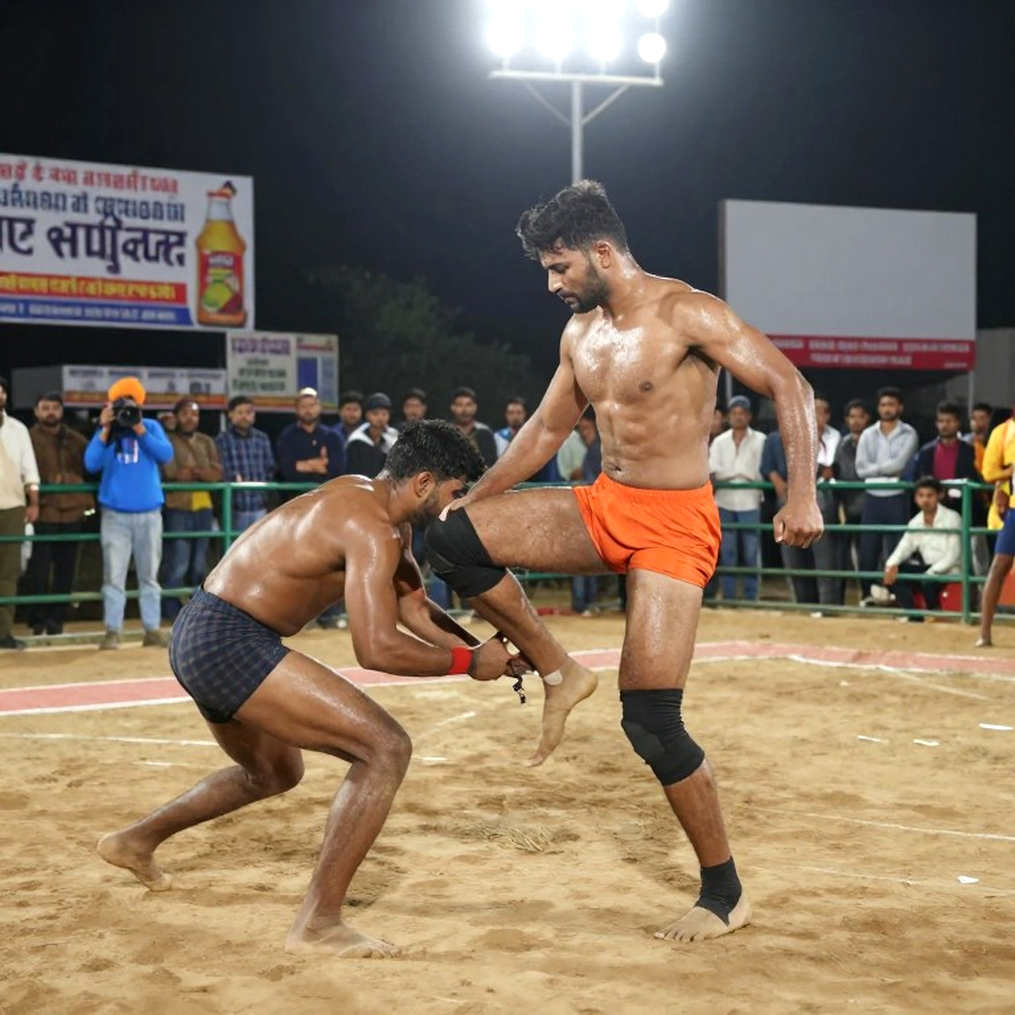
Commonwealth Kabaddi Championship 2026, Ahmedabad. Thirteen men's teams, seven in Group A and six in Group B. Five matches on the first day: Scotland 59-30 Australia, Sri Lanka 48-21, India 46-26 England, Kenya 48-28 Singapore, Uganda 45-29 Malaysia. Match totals of 89, 76, 74, 72 and 69 sit squarely inside the Standard Style band, where a game lands between 70 and 90 points. The rules are the old ones: a 30-second raid, the continuous cant, the bonus line, two points for an All Out, and a do-or-die raid after two empty ones. Anyone who has stood at mat level and watched a raider's breath break does not need to be told this sport runs on arithmetic and acoustics at once.
What the report gives us beyond the arithmetic is thin. No tackle percentage, no raid-success rate, no lineups, no qualification rules, and no statement of whether this is Standard Style or Circle Style. One individual figure exists in the entire document — Scotland's Lovepreet Brar, 23 raid points.
Start with the part that holds up honestly. Add the table backwards. Group A: Sri Lanka +27, India +20, Uganda +16. Group B: Scotland +29, Kenya +20. That fits exactly the rule every round-robin uses — wins first, then score difference. No contradiction, no broken sum. The factual layer can be trusted, and that is not a small thing. In a circuit where scoreboards get misprinted, the check earns its place.
The trouble begins one row down. A score-difference rule produces a mechanical outcome: a side that has not played yet outranks a side that played and lost. Nigeria sits fourth in Group A without a single raid. Bangladesh sits third in Group B and Canada fourth, both without playing. This is not the report's error; it is the table's design — and the direct consequence is that Day-1 standings carry almost no predictive value. In Group B especially: Bangladesh, having played nobody, is in all likelihood the strongest team in that group, and third place badly understates it.
There is a second thing nobody touched. Group A has seven teams, Group B six. In a full round-robin, one side plays six matches and the other five. The first effect is that cross-group score-difference comparison is unequal. The second is more interesting: in the smaller group a single blowout can settle top spot, so running up the margin against a weak opponent becomes rational strategy. Scotland's 59-30 is not only the story of a strong side; it is the output of a design that rewards margin. An 89-point total points to loose defensive structure on both sides, but with no tackle data that is a direction, not a proof.
Now the name the whole Commonwealth label rests on. Kabaddi is not on the Commonwealth Games programme, and this event carries no Commonwealth Games Federation sanction — it is a membership label, not a competitive tier. A label is never neutral; it filters. Iran, the undisputed number two in the sport and the only nation to have broken India's men's Asian Games gold monopoly, is not a Commonwealth member, so Iran is absent. South Korea is absent too. Thirteen teams, then, is a field that is wide at the top and cut at the top simultaneously. In Jakarta the guaranteed gold broke before the lights did, and since that night I have never written Iran's name as a surprise package. Iran is not on the mat here, and that absence is the biggest technical fact about this title.
Return to Lovepreet Brar's 23. Twenty-three of Scotland's 59 is at least 39 percent, and since a team total also carries tackle, bonus and All Out points, his share of the raid points alone is almost certainly above half. Twenty-three in one match implies three or four Super Raids. It is an excellent performance and a structural vulnerability in the same breath: Scotland's offence rests on one raider, and a disciplined chain-tackle defence can stall it. The essential caveat — the 23 demands a heavy discount for opposition quality. Australia conceded 59, the worst defensive return of the day. One match against the weakest defence is not a baseline; in PKL accounting a raider's true level needs eight to ten matches. Calling this a breakout on one evening would be premature.
The name itself carries a technical clue. Scotland, England, Canada and Australia all draw heavily on the Punjabi diaspora, and that tradition is rooted in Circle Style — a round field, one against one, village mud. A player raised there steps into Standard Style's seven-on-seven positional defence, the bonus line and the 30-second cant discipline, and a translation gap opens. Between the mud and the motherboard I found the same arena, with one difference: on mud nobody teaches organised defence, because every man carries his own. That gap is the least-written story in diaspora kabaddi, and plausibly the explanation for the 89 points in Ahmedabad.
The African sides deserve more room than the report gave them. Kenya beat Singapore 48-28 and Uganda beat Malaysia 45-29 — two comfortable wins over Asian opposition on the same day. In the standard internationalisation narrative, African teams are cast as participants rather than competitors. Two wins is a small, real signal, but with one match and no statistics the correct conclusion is worth tracking, not power shift.
India's 46-26 over England is unreadable as presented. A 20-point margin is solid, not dominant — Sri Lanka's was larger at +27. The decisive variable is missing: squad composition. The report never says whether India fielded its senior national side or a domestic development group. Until that is clear, 46-26 supports no conclusion at all.
The table could change at any time — the report offers that caveat twice, and it is technically true. A true caveat can still be an incomplete one. The problem is not that the table will change; it is that the table is being read wrong right now. Preliminary is doing the work of a shield here, reassuring the reader that what is visible is partial but honest, when three teams are sitting mid-column purely because they have not raided.
The word internationalisation needs the same audit. Thirteen countries is breadth, not depth. In a field missing the world's second power, there is no yardstick left for India's dominance — and without a yardstick, dominance stories slide quickly into celebration. One technical gap stays open: Standard or Circle Style is nowhere stated. If officiating is being read loosely on the ground, every number changes meaning.
On day two I will be watching three things: Bangladesh's opening match, India's squad sheet, and whether qualification rules are ever published. The scoreboard will change every evening. The question is whether a single tackle figure gets printed — because season five filled ninety-six pages, and the loudest page was silent. The mic runner hears the story before the stadium does; right now the stadium does not even have a mic.